If you have looked into SEO tools lately, you have probably run into the name Semrush. This Semrush review breaks down why it shows up in almost every marketing conversation, and whether it deserves the hype in 2026.
Here, you’ll find what Semrush actually does, what it costs, and whether it earns a spot in your marketing stack. No fluff, no filler, just what you need to decide.
In this guide: What Semrush is, core features, pricing across every toolkit, integrations, pros and cons, real user reviews, competitor comparisons, and answers to the most common Semrush questions.
What Is Semrush?
Semrush is a digital marketing suite built by Semrush Inc. It combines SEO, content, PPC, and social tools into a single dashboard rather than 10 separate apps.
Think of it as a command center for anyone who needs to track rankings, research keywords, spy on competitors, and manage ad campaigns without constantly switching platforms.

Who Semrush Is Built For
Semrush works best for agencies juggling multiple client accounts, in-house marketing teams, and freelancers who need serious data without hiring a research team.
Only bloggers with a single small site might find it overkill. Semrush shines when you are managing several websites or competing in a crowded niche.
What Does Semrush Do
At its core, Semrush pulls data from a massive keyword and backlink database, then turns that raw data into reports you can act on the same day.
You get organic traffic estimates, competitor keyword gaps, backlink profiles, and now, visibility tracking across AI search tools like ChatGPT and Google AI Mode.
Semrush Review Summary
Semrush earns a strong 4.5 to 4.6 out of 5 on G2, based on thousands of ratings from agencies and marketing teams across different industries in 2026.
Pricing starts around $139.95 a month for the Pro plan, with a free trial available. It is best suited for teams that need depth over simplicity.
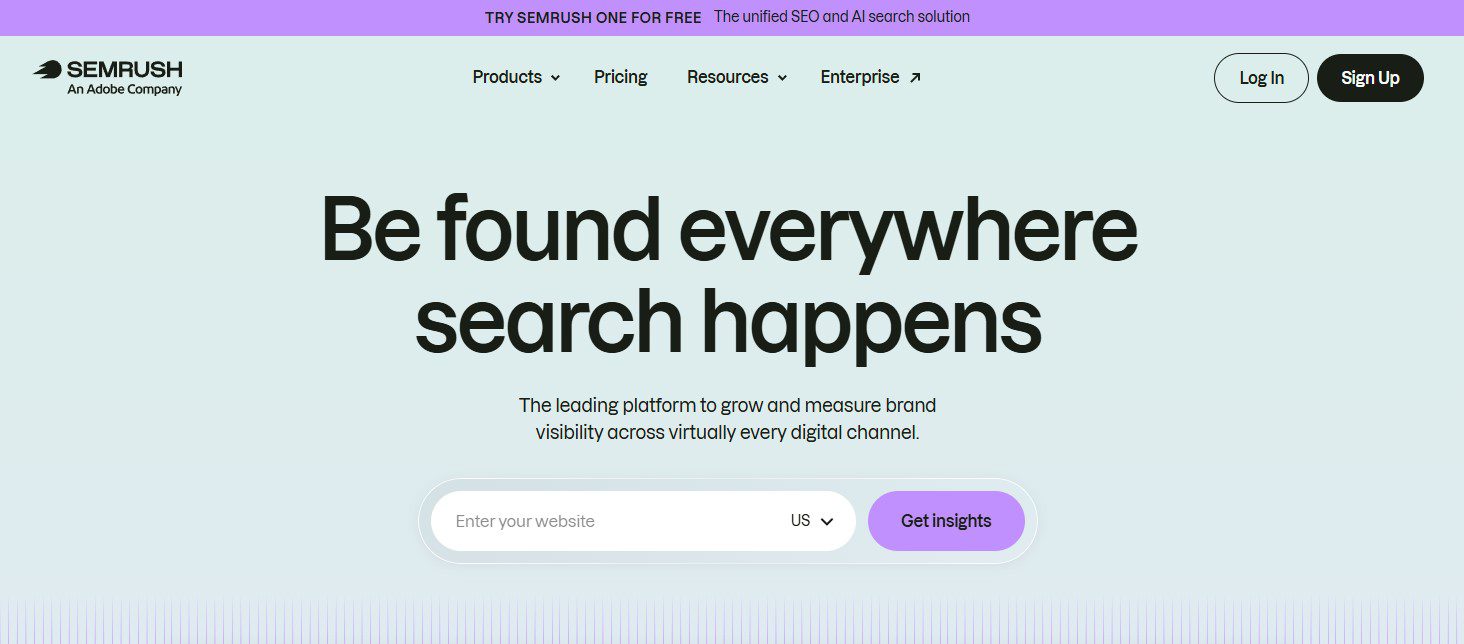
Quick take: Best for agencies and multi-channel marketers who need SEO, PPC, content, and AI visibility tracking in one place. Not ideal if you only need basic on-page fixes for a single small site.
How We Tested Semrush
Properly judging an SEO platform means looking beyond the marketing page. Here is what actually matters when scoring a tool like this one.
Core Functionality
Does Semrush deliver the basics well? Keyword research, site audits, and rank tracking all need to work reliably before anything else counts toward a fair score.
Ease of Use
A tool only helps if your team can actually use it. We looked at how quickly someone unfamiliar with the platform could find what they needed.
Onboarding
New users need a smooth start. We checked how much guidance Semrush offers through tutorials, tooltips, and walkthroughs during the first few sessions on the platform.
Customer Support
Getting stuck is inevitable with a tool this big. Live chat response time, refund handling, and help center quality all factor into how support gets scored here.
Value for Money
Price only matters next to what you get for it. We compared Semrush’s cost with the depth of its feature set, data accuracy, and update frequency.
Semrush Overview
Founded in 2008, Semrush has become a leading digital marketing platform trusted by agencies and marketing professionals worldwide.
Semrush Specs
Semrush Core Features
Semrush packs a lot into one platform. Here is a breakdown of the tools that matter most for everyday SEO and marketing work.
Keyword Research
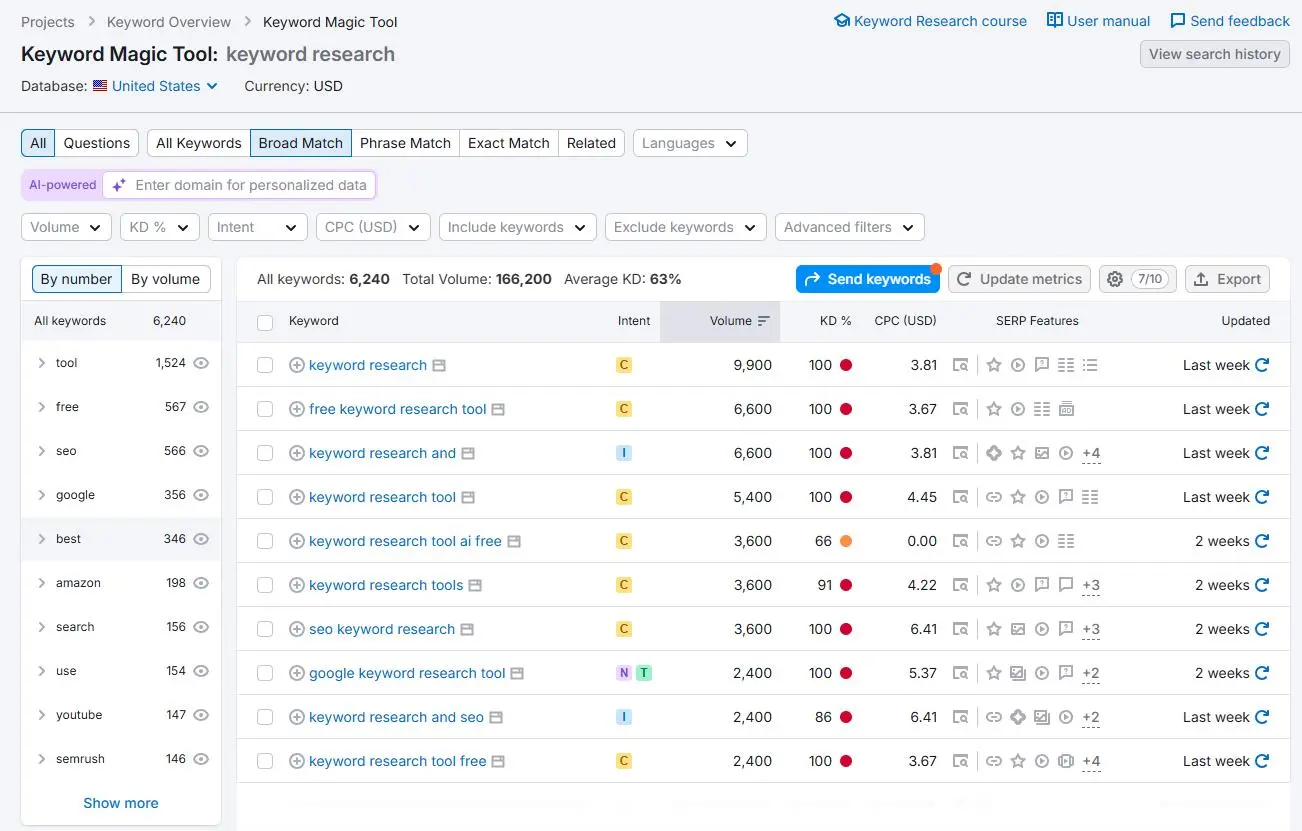
The Keyword Magic Tool takes one seed keyword and returns thousands of related terms for deeper keyword research, filtered by search volume, keyword difficulty, and search intent.
Add your own domain, and Semrush generates a personalized keyword difficulty score based on your site’s existing authority, not just generic industry averages.
Site Audit & Technical SEO
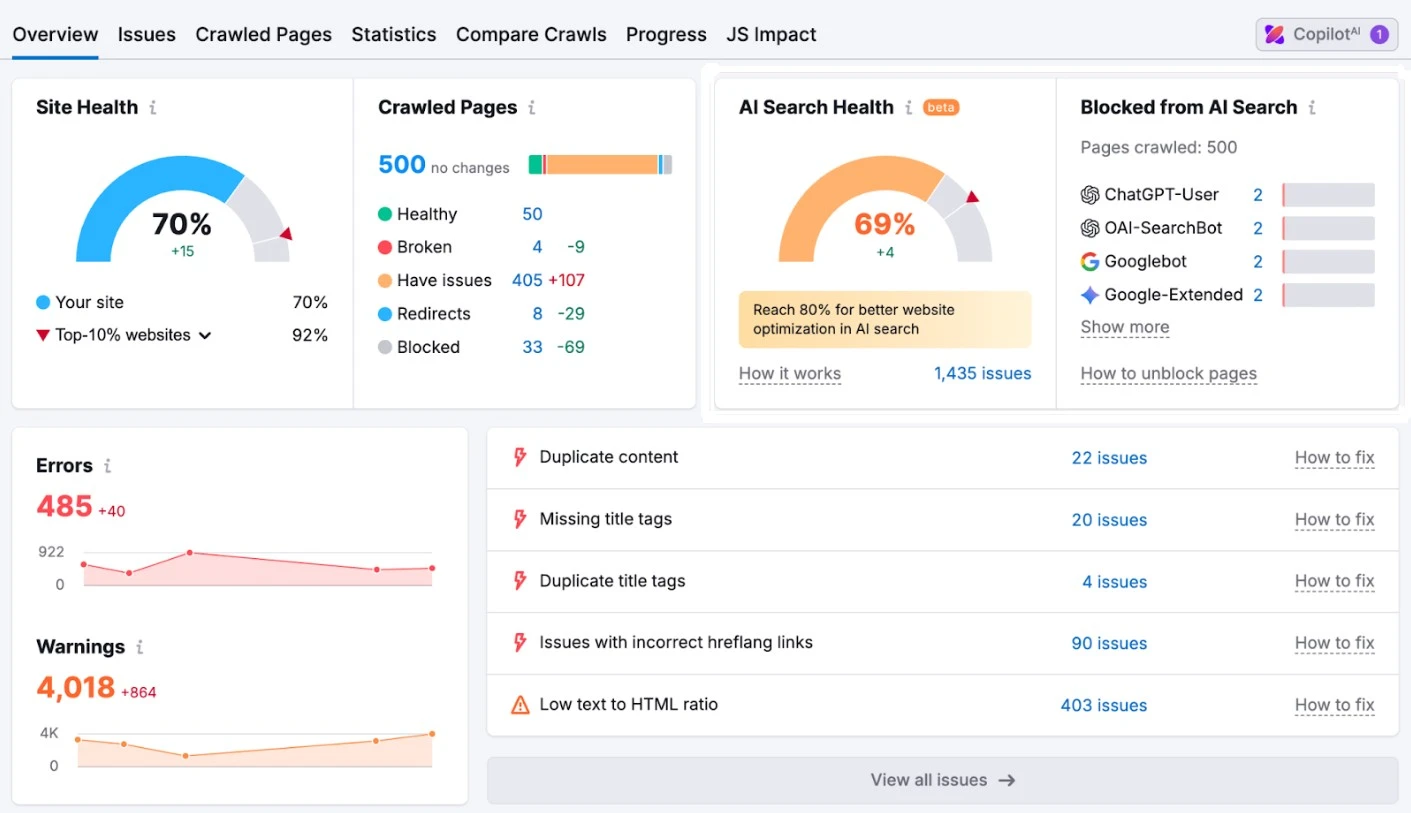
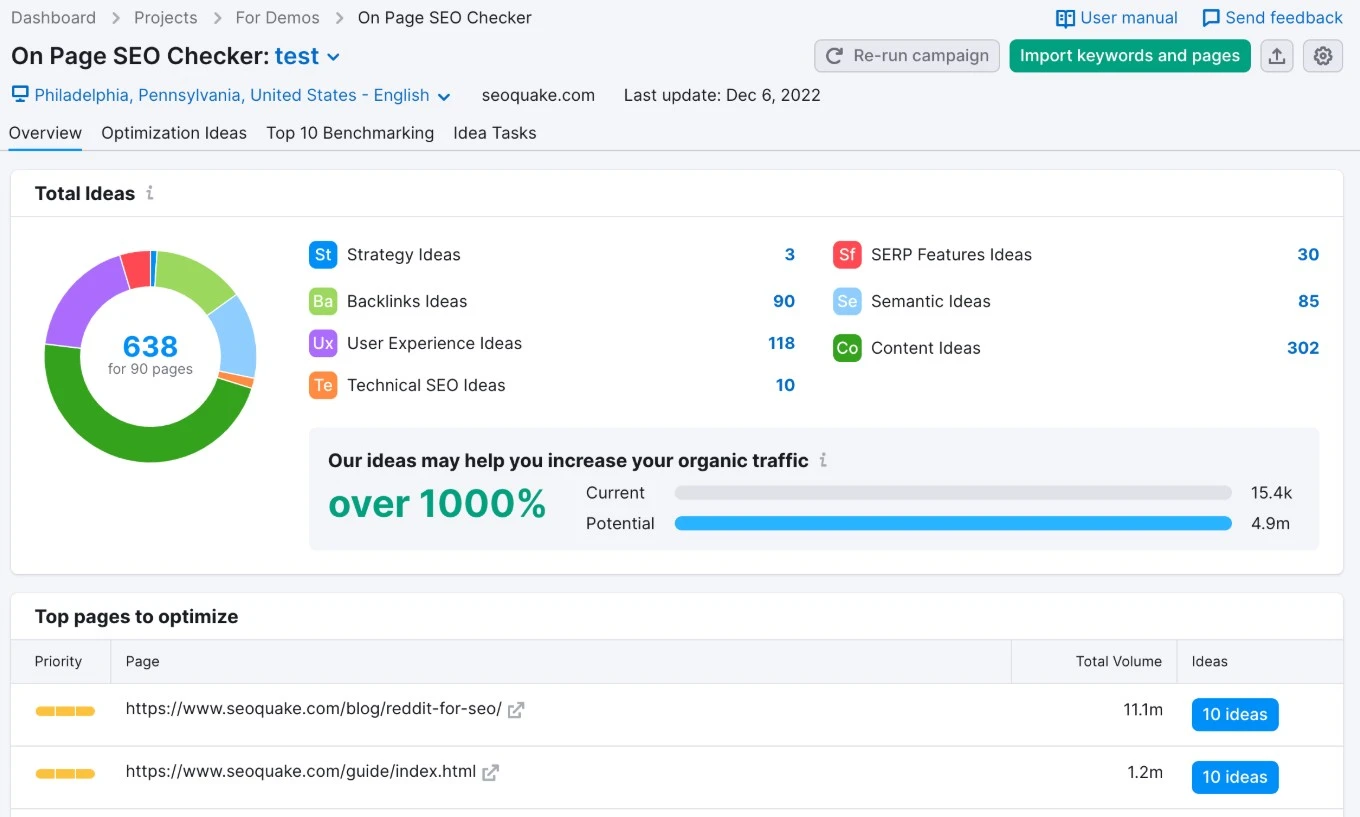
Site Audit scans your entire website and flags crawlability issues, slow pages, broken links, and missing metadata that could be hurting your rankings right now.
It scores your site with a simple health percentage, so you can see progress over time as you fix flagged issues one by one, the same way any solid SEO audit tool should.
Position Tracking
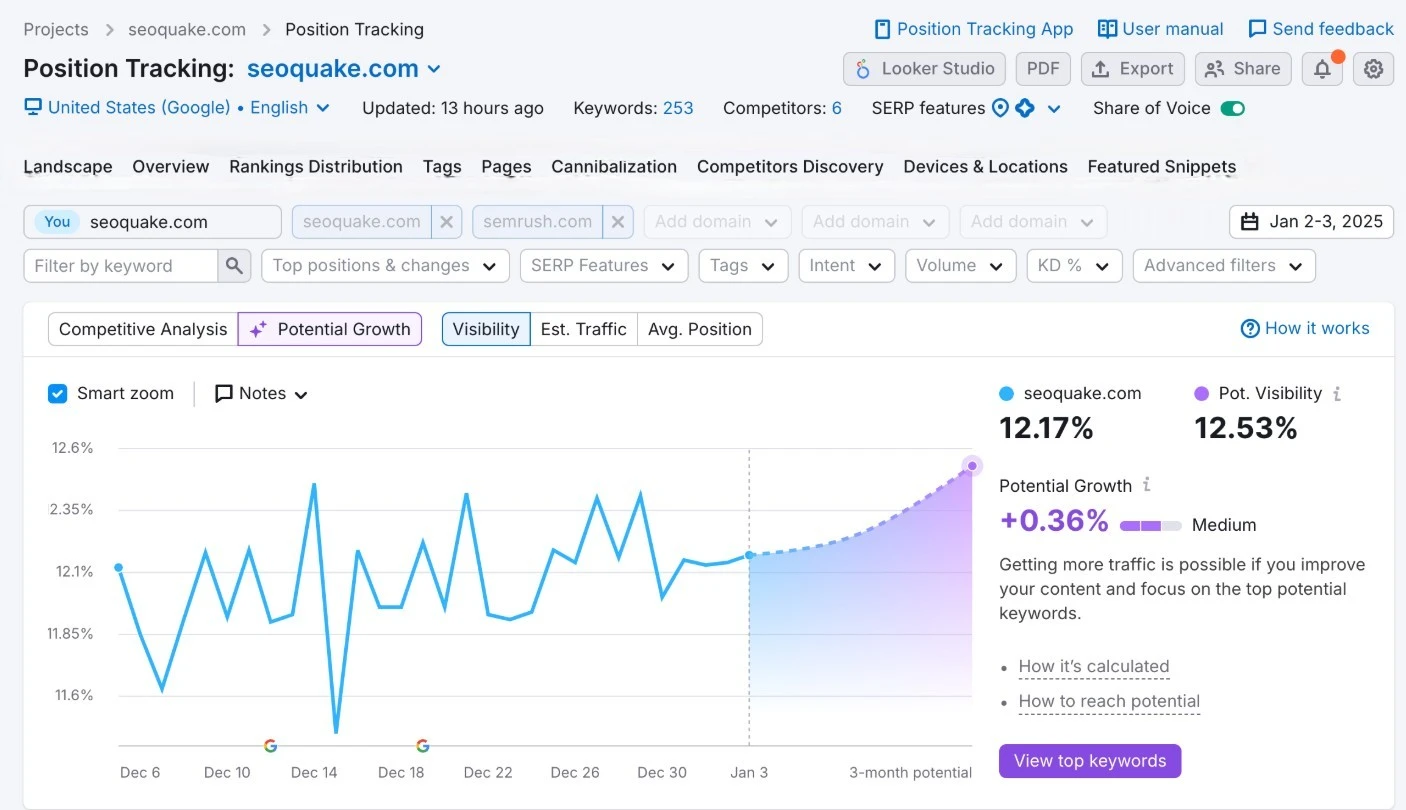
This feature monitors your keyword rankings daily across desktop and mobile, and even tracks positions on Bing and AI search tools like ChatGPT and Google AI Mode.
A built-in cannibalization report flags pages competing for the same keyword, which is easy to miss without a reliable rank-tracking tool.
Backlink Analysis & Gap
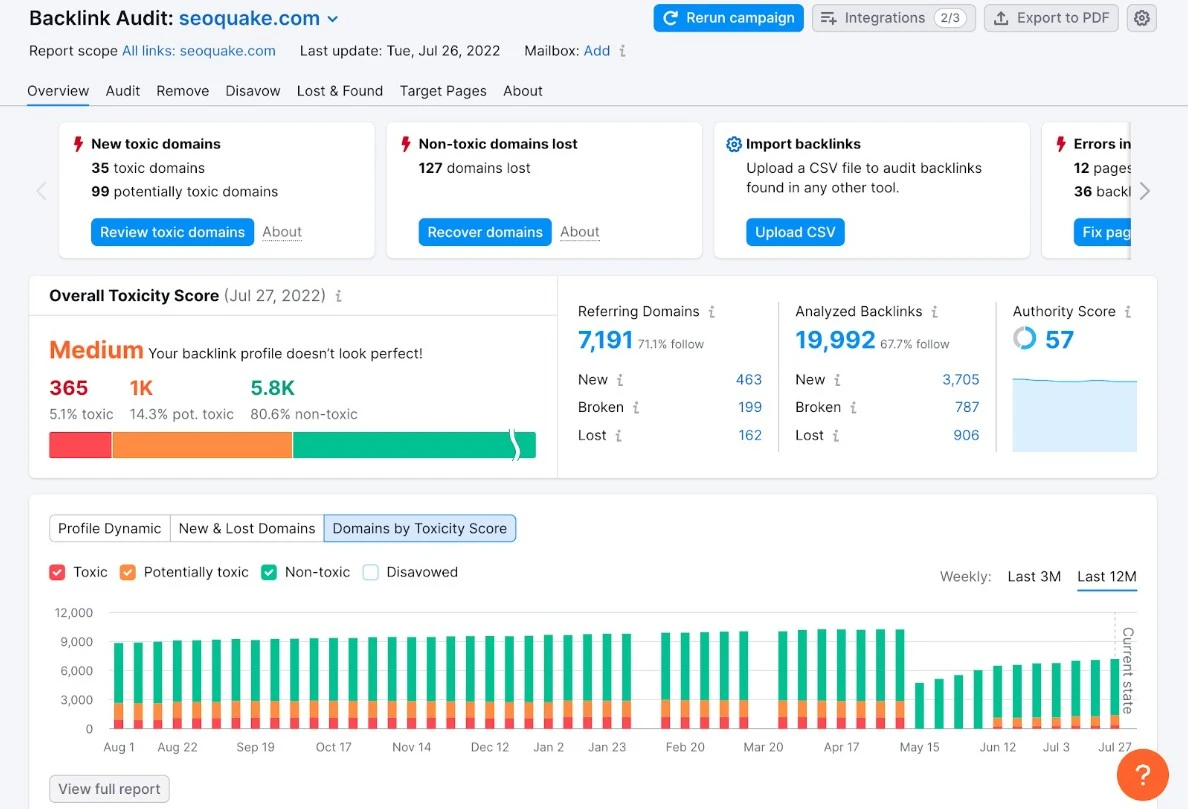
Semrush’s backlink monitoring checker draws from a database of over 43 trillion links. It clearly shows referring domains, anchor text patterns, and toxic link warnings.
The Backlink Gap tool compares your link profile with competitors, surfacing sites that link to them but not to you, sorted by authority.
Competitor Analysis & Traffic Analytics
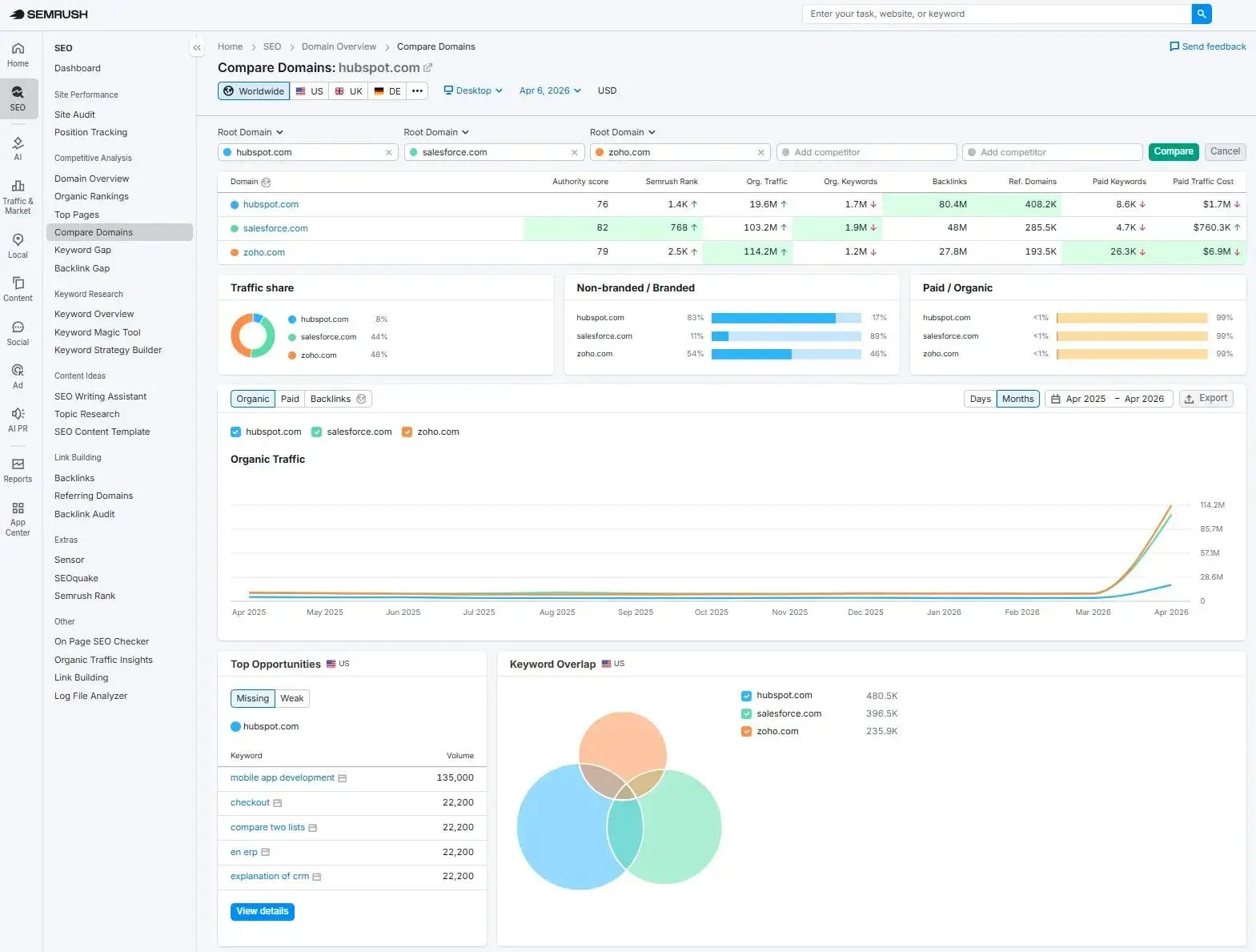
Domain Overview provides a quick snapshot of a site’s organic traffic, paid traffic, and backlink count, useful for competitor analysis and sizing up rivals quickly.
Traffic Analytics, one of Semrush’s built-in website traffic checker tools, breaks down where a competitor’s visitors come from, which channels drive the most volume, and how they behave once they land.
Content Marketing Toolkit
Topic Research pulls content ideas from articles that are already performing well in your niche, complete with related questions and headline ideas for writers.
The SEO Writing Assistant checks readability, tone, and originality as you write, much like other AI writing tools, which helps keep content consistent across a team of multiple writers.
Local SEO Toolkit
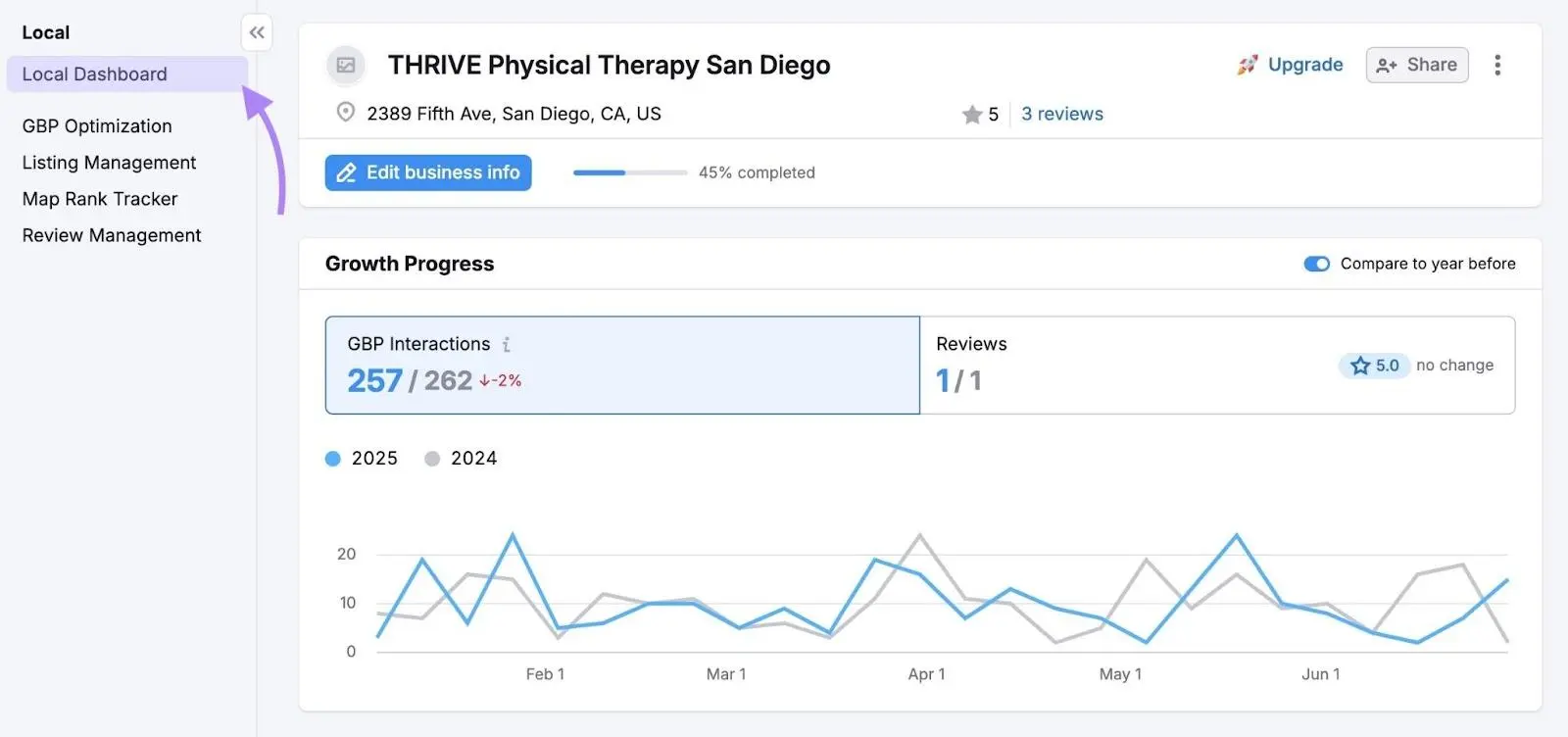
For businesses with a physical location, the Local Toolkit manages Google Business Profile listings, tracks local pack rankings, monitors reviews, and audits citation accuracy.
It also flags incorrect business listings across directories, which can quietly erode local visibility and customer trust if left unchecked for months.
PPC & Advertising Research
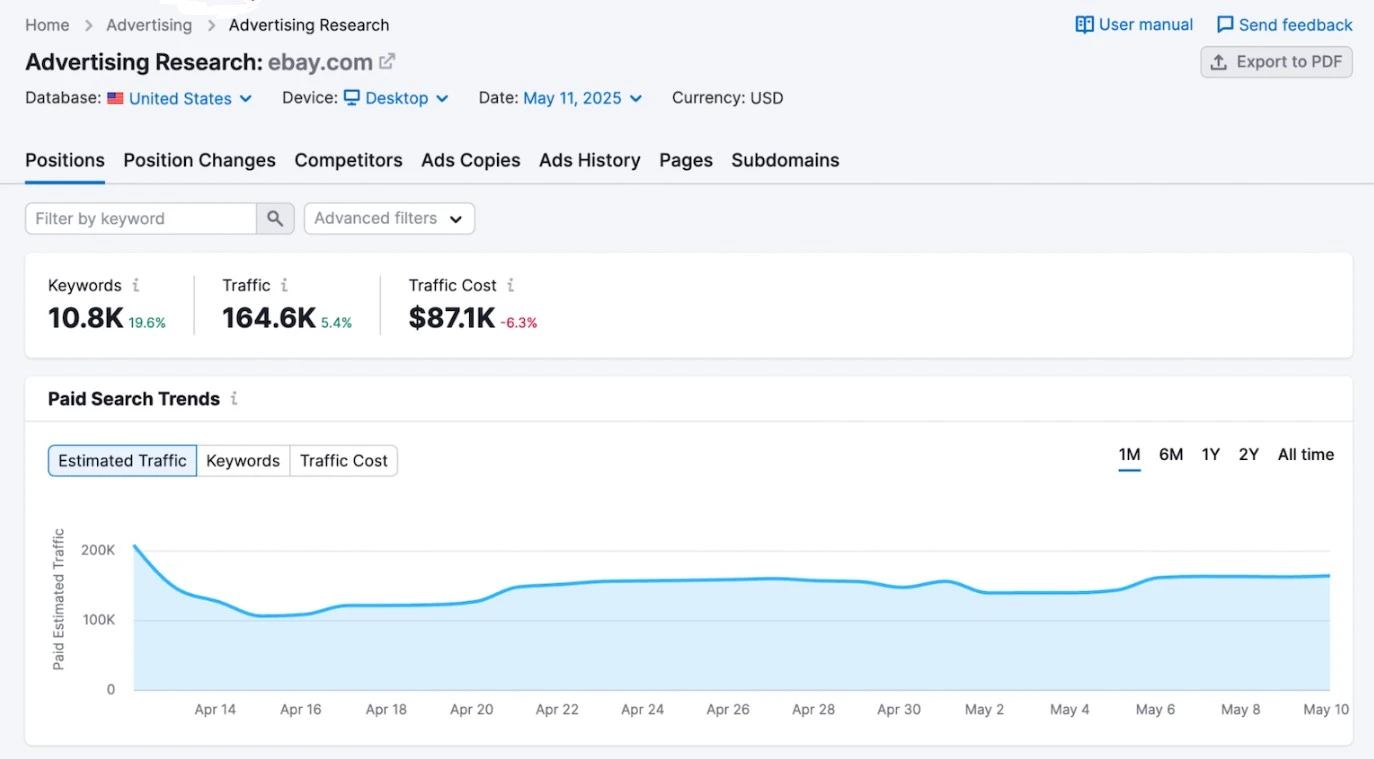
Semrush lets you see the exact ads your competitors are running, how long they have been running, and roughly how much they are spending each month.
Ads that stick around for months are usually working, so this data gives you a shortcut to proven ad copy ideas for your own upcoming campaigns.
AI Visibility & Brand Performance
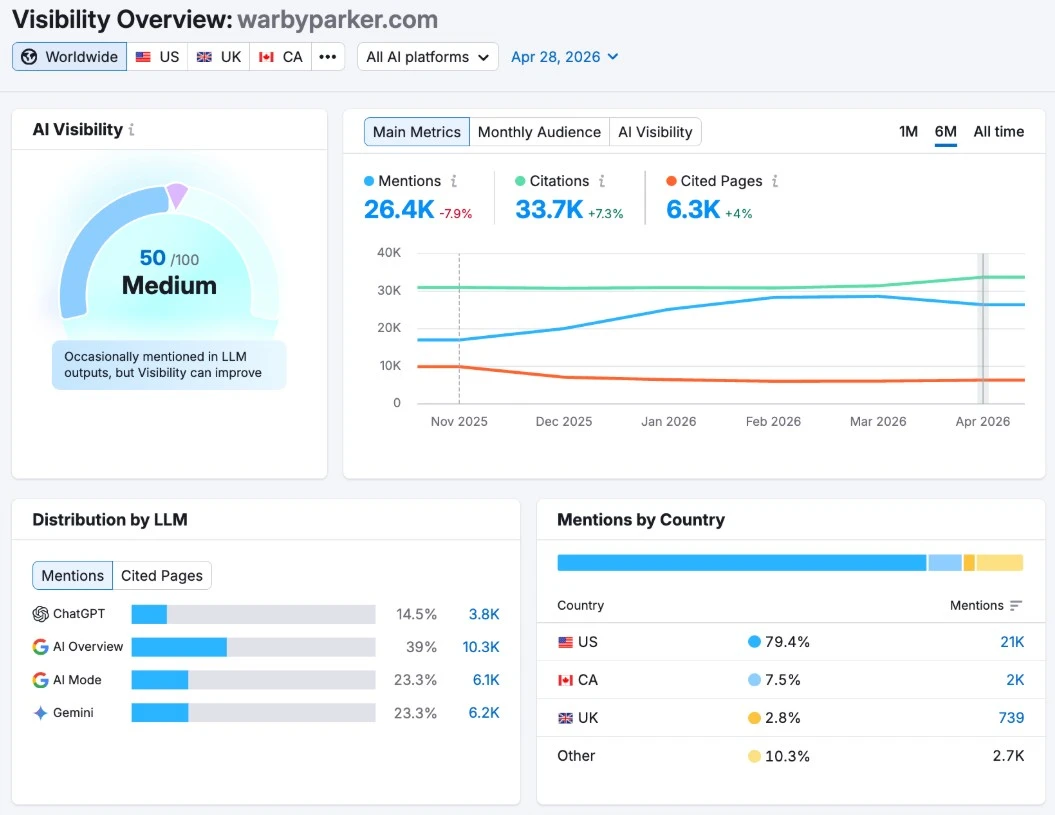
This is Semrush’s newest addition, tracking how often your brand appears in AI-generated responses from tools like ChatGPT, Perplexity, and Gemini.
It also measures sentiment, meaning whether AI tools mention your brand positively or negatively, which is becoming just as important as traditional search rankings.
Semrush Integrations
Semrush integrates with the tools most marketing teams already use, reducing manual exporting and keeping reporting workflows in one place.
Supported integrations include Google Analytics, Google Search Console, HubSpot, Slack, Asana, Jira, and Zapier, as well as Google Ads and Google My Business.
For example, connecting Google Search Console lets Semrush blend its own keyword data with your actual click and impression numbers straight from Google. This gives a clearer picture than either tool alone.
Agencies often connect Slack or Asana too, so Site Audit alerts and ranking drops land directly in the channel or board the team already checks daily, instead of getting buried in email.
Semrush One: The All-in-One Bundle
Semrush One is the newer flagship bundle that merges traditional SEO tracking with AI visibility monitoring under a single subscription and dashboard.
It covers classic Google rankings alongside how your brand appears in ChatGPT, Gemini, and Google AI Mode, which used to require separate tools entirely.
For brands that care about both search and AI visibility, this bundle works out cheaper than buying the SEO Toolkit and AI Toolkit separately.
It makes the most sense for teams already tracking traditional rankings who want AI search visibility added without managing a second subscription or dashboard.
Semrush for Specific Use Cases
Not every business needs every feature. Here is how Semrush fits a few common situations marketers run into day-to-day.
Semrush for Agencies
Agencies benefit most from the reporting tools, which let you build white-label reports and manage multiple client accounts from a single login, saving hours each week.
Semrush for Local Businesses
Local shops get real value from the Local Toolkit alone, without needing the full SEO suite, thanks to flexible standalone add-on pricing options.
Semrush for Ecommerce & SaaS
Product-led businesses can leverage Keyword Gap and the Content Toolkit to uncover untapped search demand for specific product categories and comparison terms.
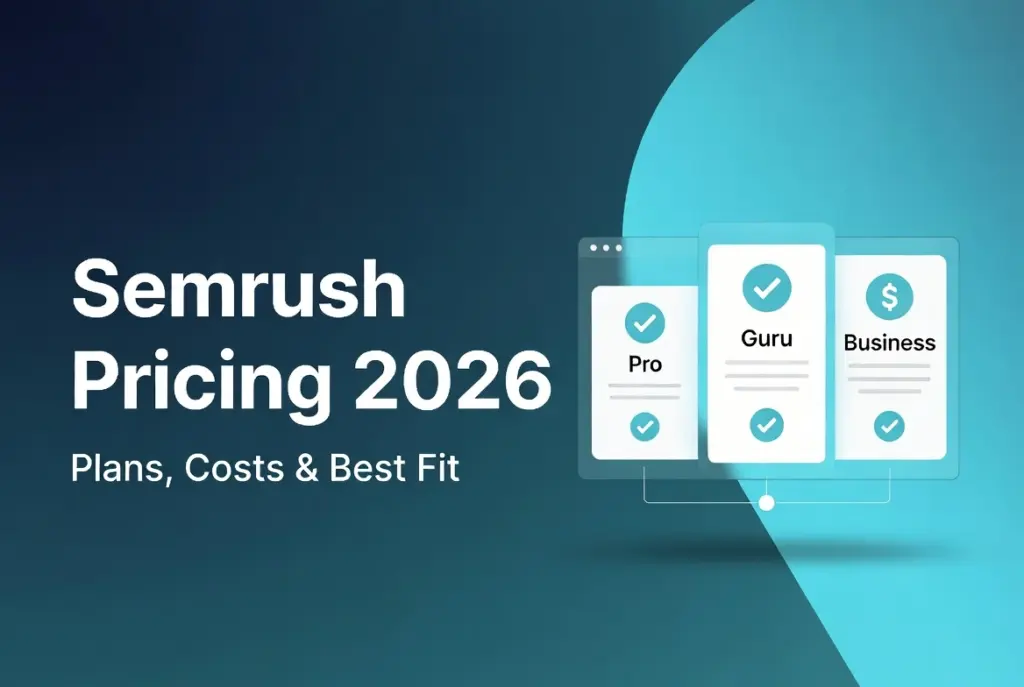
Semrush Pricing in 2026
Semrush pricing depends on which toolkit or bundle you choose, and costs can add up quickly if you need more than just basic SEO tools.
The Pro plan covers 5 projects and 500 tracked keywords, enough for solo marketers or very small teams starting with SEO.
Guru adds the Content Marketing Toolkit, historical data, and Looker Studio integration. Business unlocks API access, PLA analytics, and much higher tracking limits.
Other Toolkit Pricing
Beyond the core SEO plans, Semrush prices its remaining toolkits separately, which matters if you only need one specific function.
Free Trial & Free Version
Semrush offers a free trial and a limited free plan that lets you test core tools before committing to a paid subscription.
Semrush Pros and Cons
No platform is perfect, and Semrush is no exception. Below is a fair assessment of its biggest strengths and drawbacks based on real-world experience.
Pros
- Massive keyword and backlink database, among the largest in the industry.
- Combines SEO, PPC, content, and social tools in a single dashboard.
- Strong AI visibility tracking, ahead of most competitors on this front.
- Detailed reporting features built for agencies managing multiple clients.
- Semrush One bundle offers AI and SEO tracking at a lower combined cost.
Cons
- Steep learning curve for anyone new to SEO software.
- Pricing climbs quickly once you add extra toolkits.
- The interface can feel cluttered with so many tools packed in.
- Traffic estimates do not always match Google Analytics exactly.
- Refund and cancellation process draws mixed feedback from users.
Semrush Ease of Use & Interface
New users often need a few sessions before Semrush feels intuitive. The sheer number of tools means it can take 3 to 5 clicks to reach a specific report.
For example, finding a specific competitor’s paid ad history means navigating through Advertising Research first, then the Ads Copies tab, rather than a single search bar getting you there directly.
Although it takes some time to learn the platform, the dashboards become highly valuable once you’re familiar with them, making it easy to identify trends and respond quickly.
Customer Reviews & Trust Signals
Semrush holds strong ratings on review platforms like G2, averaging around 4.5 out of 5 stars from thousands of verified marketing professionals.
The picture looks different on Trustpilot, where ratings drop closer to 2 out of 5. Most negative reviews there center on billing and cancellation friction, not the tools themselves.
This split matters. If you plan to subscribe, read the cancellation policy closely and set a calendar reminder before any trial period ends.
Semrush Customer Support
Semrush offers live chat support along with an extensive help center covering nearly every tool on the platform in detail, with step-by-step guides.
Response times are generally fast for live chat, often within a few hours for straightforward requests like cancellations or refund questions.
Knowledge base articles are thorough but sometimes text-heavy, so newer users may need extra time to work through denser tutorials without screenshots.
Semrush vs Competitors
Choosing between SEO tools often comes down to specific needs. Here is how Semrush compares to three popular alternatives.
Semrush vs Ahrefs
Both tools are close competitors. Ahrefs tends to have a cleaner, simpler interface and slightly better internal link analysis on a page-by-page basis.
Semrush pulls ahead on competitor research, PPC data, and its newer AI visibility features, making it the stronger pick for broader marketing needs beyond SEO alone.
Semrush vs Moz Pro
Moz Pro is more beginner-friendly and cheaper, but its keyword database is far smaller, sitting around 1.25 billion keywords compared to Semrush’s 26 billion.
Moz suits smaller sites focused on basics. Semrush suits teams that need scale and depth across SEO, PPC, and content research combined.
Semrush vs Serpstat
Serpstat is a budget alternative with decent keyword and rank-tracking tools, but it lacks the AI visibility and advertising research that Semrush now offers.
If cost is the main concern and your needs are simple, Serpstat can work fine. For everything else, Semrush covers noticeably more ground.
Who Should Use Semrush (and Who Shouldn’t)
Semrush fits agencies, in-house teams, and businesses running SEO alongside PPC or social campaigns that need everything managed in one place.
Semrush is a great fit for agencies and marketing teams that oversee multiple client accounts or websites. Features like Position Tracking, Backlink Gap, and automated reporting make it easy to manage dozens of projects efficiently.
Brands investing in AI search visibility also get real value here, since the AI Visibility Toolkit covers ground that most dedicated SEO tools still do not touch.
It is probably not worth it for solo bloggers focused only on basic on-page SEO, where a lighter plugin like Rank Math may cover enough ground for less money.
Small local businesses with a single location may also find the full suite excessive. The standalone Local Toolkit alone often covers what they actually need.
Is Semrush Worth It? Final Verdict
Yes, for most agencies and serious marketing teams, Semrush earns its price tag. The keyword database, backlink index, and AI visibility tools are hard to match elsewhere.
Smaller teams with simple needs might feel like they are paying for features they will never touch. Match the plan to your actual workload before committing to anything.
According to Search Engine Journal, tools that combine traditional SEO with AI visibility tracking are becoming standard practice for competitive marketing teams heading into 2026.
Ready to Explore More Reviews?
This review followed the same process behind everything published on The Tool Marketer, hands-on testing and structured evaluation, not paid placements or vendor bias. If a tool falls short, we say so.
For more honest breakdowns like this one, our tool guides cover software across SEO, content, automation, and analytics, so you can compare options without trialing everything yourself.
Frequently Ask Questions
Is Semrush worth it?
Yes, for agencies and teams that need deep keyword, backlink, and competitor data in one platform. Smaller sites with simple needs may not need the full suite.
How much is Semrush?
Plans start around $139.95 a month for the Pro tier, climbing to roughly $499.95 a month for the Business plan with higher limits and API access.
What is Semrush?
Semrush is a comprehensive digital marketing platform covering SEO, PPC, content marketing, social media, and AI visibility tracking for businesses of all sizes.
What does Semrush do?
It provides keyword research, site audits, rank tracking, backlink analysis, competitor insights, and AI search visibility data through a single dashboard.
Does Semrush support AI visibility tracking?
Yes, Semrush’s AI Visibility Toolkit tracks brand mentions and sentiment across AI tools like ChatGPT, Perplexity, and Google AI Mode, alongside traditional SEO metrics.